
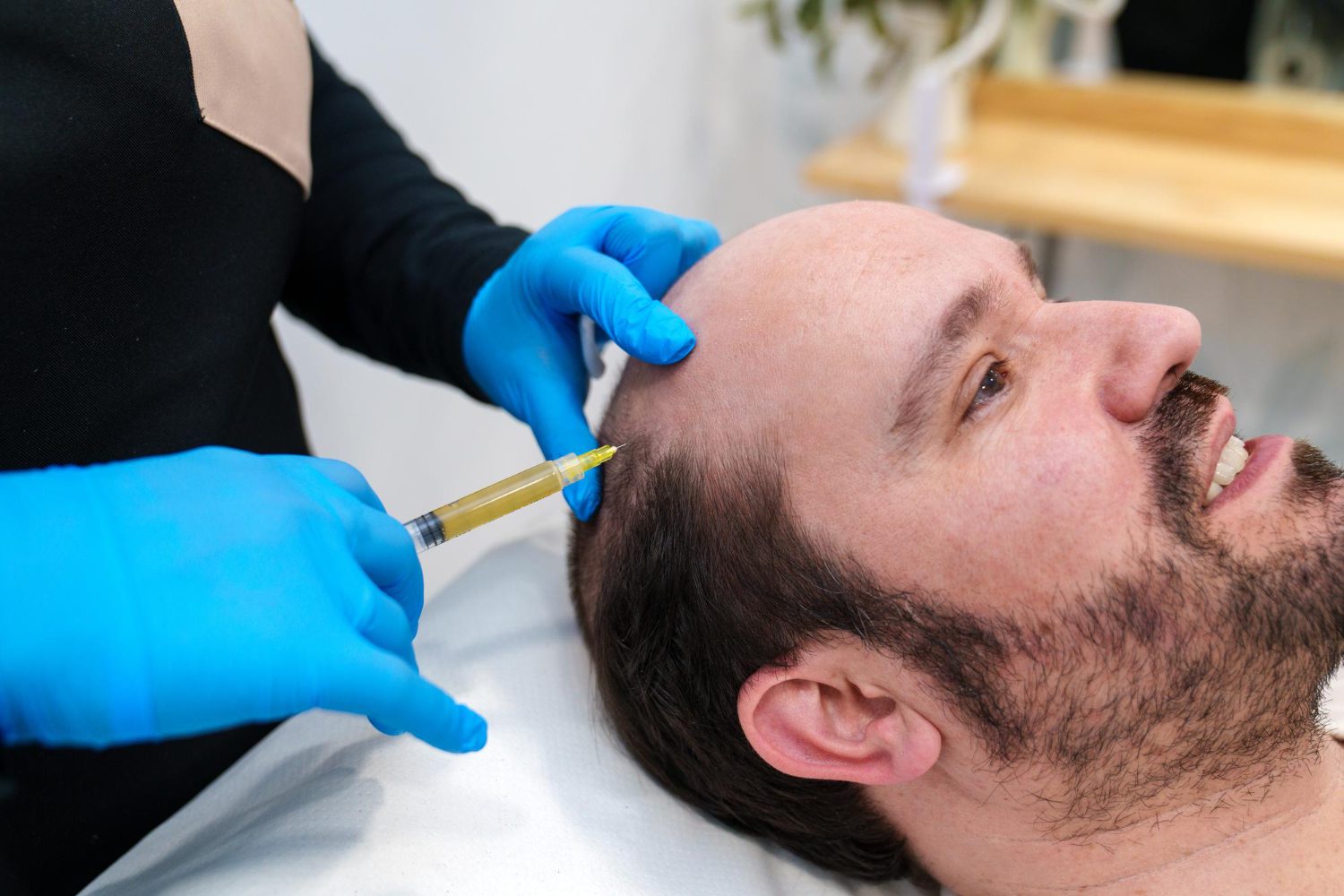
Hair thinning can show up as a widening part, receding hairline, increased shedding, or reduced scalp coverage. If you are looking for a non-surgical option, you may be considering PRP Hair Treatment.
PRP, or platelet-rich plasma, is prepared from your own blood and contains concentrated platelets and growth factors. It is then introduced into areas of the scalp affected by hair loss.
The short answer: PRP may improve hair density and reduce hair loss in some appropriately selected patients, but results vary, and it is not a guaranteed cure for baldness.
If you are considering treatment locally, you can review the PRP Hair Treatment service at H-Bling Wellness.
Research is encouraging, particularly for some forms of pattern hair loss.
A 2025 systematic review and meta-analysis of 43 randomized controlled trials involving 1,877 participants found moderate evidence that PRP can improve hair density and reduce hair loss. However, study protocols varied considerably, and the analysis did not find a significant overall improvement in individual hair thickness. Read the 2025 PRP systematic review on PubMed
The American Academy of Dermatology also lists platelet-rich plasma among treatments that may be used for hair loss. American Academy of Dermatology hair-loss guidance
The important point is that PRP should not be presented as a treatment that automatically restores a full head of hair. Results depend on factors such as the type and duration of hair loss, follicle condition, treatment protocol, and individual response.
Platelet-rich plasma is produced from a sample of your own blood.
A healthcare professional draws blood and processes it in a centrifuge to separate and concentrate the platelet-containing plasma. The prepared PRP is then injected into targeted areas.
Because the material comes from your own blood, PRP is described as an autologous treatment. Platelets contain growth factors involved in healing and tissue signaling. Johns Hopkins PRP treatment overview
PRP is not suitable for every cause of hair loss.
It is commonly studied for androgenetic alopecia, also known as male-pattern or female-pattern hair loss. People with thinning hair and follicles that are still capable of producing hair may have a different outlook from those with long-standing areas of advanced baldness.
Before treatment, it is important to determine why the hair loss is happening. Hair shedding can have many possible causes, including hereditary hair loss, hormonal changes, illness, medications, nutritional problems, autoimmune conditions, scalp disorders, or traction.
The American Academy of Dermatology emphasizes that effective treatment begins with identifying the cause of hair loss.
Sudden, severe, patchy, painful, or inflammatory hair loss should receive appropriate medical evaluation rather than automatically being treated with PRP.
A typical treatment includes:
At H-Bling Wellness in Brea, the current service combines PRP injections with SkinPen microneedling of the scalp. Learn more about H-Bling Wellness
Treatment techniques can differ between practices, so ask exactly how your PRP will be prepared and delivered.
There is no universal treatment schedule.
H-Bling Wellness currently describes a typical treatment series as 3 to 6 sessions spaced about 4 to 6 weeks apart, with maintenance treatments potentially recommended afterward.
Other providers use different protocols. Cleveland Clinic, for example, describes an initial treatment series followed by progressively spaced maintenance treatments. Cleveland Clinic PRP hair therapy guidance
Your treatment schedule should therefore be individualized rather than based on a universal number of sessions.
PRP is not an instant hair-growth treatment.
Hair grows slowly, so changes generally develop over several months. Cleveland Clinic notes that improvement may begin around three months under its protocol, while Johns Hopkins states that scalp PRP results may be most noticeable around six months.
Progress photos taken under consistent lighting and positioning can make changes easier to evaluate.
Not necessarily.
Progressive forms of hair loss may continue over time, even after improvement from treatment. Maintenance sessions or other appropriately selected treatments may therefore be recommended.
Johns Hopkins notes that results from scalp PRP injections are not permanent and additional treatment may be needed.
PRP is generally considered a relatively low-risk procedure when properly performed, but low risk does not mean zero risk.
Possible effects include:
Johns Hopkins describes PRP as a low-risk procedure but lists possible complications including bleeding, infection, tissue damage, and nerve injury.
Tell your provider about your medical conditions, medications, supplements, and any medicines that affect bleeding. Do not stop prescription medication simply to undergo PRP unless the clinician managing that medication tells you to do so.
This distinction is important.
PRP preparation equipment may receive FDA clearance for specific uses, but that does not mean PRP Hair Treatment has blanket FDA approval for treating hair loss.
FDA records include platelet and plasma separation systems cleared for specific applications such as preparing PRP for use in bone-graft handling. View an FDA PRP preparation-device record
Johns Hopkins also explains that PRP procedures remain investigational for many uses and should not be described simply as “FDA approved PRP.”
Treatment | Main Approach | Important Consideration |
PRP | Uses platelet-rich plasma prepared from your blood | Usually requires a treatment series and possible maintenance |
Minoxidil | Medication used for certain forms of hair loss | Continued treatment may be needed to maintain benefit |
Hair Transplant | Surgically relocates viable hair follicles | More invasive and involves surgical recovery |
These options are not always competitors. Depending on the diagnosis, healthcare professionals may use more than one strategy.
Cleveland Clinic notes that PRP can be used alongside established hair-loss treatments rather than automatically replacing them.
If you are researching PRP Hair Treatment in Brea, CA, H-Bling Wellness offers a treatment combining platelet-rich plasma with SkinPen microneedling.
A consultation should help determine:
Choosing treatment should begin with understanding the cause of hair loss rather than simply choosing the most popular procedure.
PRP may improve hair density and support hair growth in some patients, particularly with appropriate types of hair loss. Complete regrowth should never be guaranteed.
It may improve overall density, but the 2025 meta-analysis did not find a significant overall improvement in individual hair thickness.
Results depend partly on whether viable follicles remain. PRP should not be expected to reliably restore advanced areas where functioning follicles are no longer present.
Many people return to normal activities relatively quickly, although tenderness, soreness, bruising, or swelling may occur. Follow the specific aftercare instructions provided by your healthcare professional.
PRP Hair Treatment may be worth discussing for people experiencing certain types of thinning hair or hair loss, but it works best when expectations are realistic and the underlying cause of hair loss has been properly evaluated.
Research suggests PRP can improve hair density and reduce hair loss in some patients, but treatment response varies and evidence still has limitations.
If you are considering PRP Hair Treatment in Brea, CA, contact H-Bling Wellness to discuss your hair concerns and whether PRP may be appropriate for your goals.